Afghanistan National Cricket Team vs Australian Men’s Cricket Team Timeline
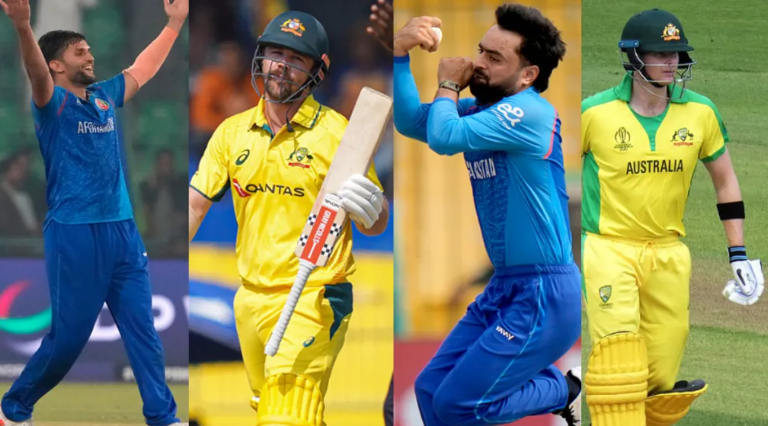
Table of Contents
This rivalry is not defined by how often Afghanistan and Australia have played, but by how deeply their encounters have resonated. It is a story of contrast, courage, and consequence. Afghanistan arrived carrying belief forged through struggle, while Australia stood guarded by legacy and expectation. Every meeting has felt heavier than the schedule suggested, shaped by pressure, resilience, and moments that refused to follow script. What began as a curiosity has evolved into a contest that commands respect, where scorecards reveal tension and performances reshape perception. This timeline captures how two very different cricketing worlds collided and changed each other in the process.
Latest Matches: Afghanistan National Cricket Team vs Australian Men’s Cricket Team Timeline
| Tournament | Venue | Date | Toss | Afghan Score | Australian Score | Result | Series | Player of the Match |
|---|---|---|---|---|---|---|---|---|
| ICC Champions Trophy | Gaddafi Stadium, Lahore | Feb 28, 2025 | Afghan (bat) | 273 (50 ov) | 109/1 (12.5 ov) | No result (abandoned due to rain) | ICC Champions Trophy 2025 | Not awarded |
| ICC Men’s T20 World Cup | Arnos Vale Ground, Kingstown | Jun 23, 2024 | Australian (bowl) | 148/6 (20 ov) | 127 (19.2 ov) | Afghan won by 21 runs | ICC T20 World Cup 2024 | Gulbadin Naib (AFG) |
| ICC Cricket World Cup | Wankhede Stadium, Mumbai | Nov 7, 2023 | Afghan (bat) | 291/5 (50 ov) | 293/7 (46.5 ov) | Australian won by 3 wkts | ICC Cricket World Cup 2023 | Glenn Maxwell (AUS) |
| ICC Men’s T20 World Cup | Adelaide Oval, Adelaide | Nov 4, 2022 | Afghan (bat) | 168/8 (20 ov) | 164/7 (20 ov) | Australian won by 4 runs | ICC T20 World Cup 2022 | Adam Zampa (AUS) |
| ICC Cricket World Cup | County Ground, Bristol | Jun 1, 2019 | Afghan (bat) | 207 (38.2 ov) | 209/3 (34.5 ov) | Australian won by 7 wkts | ICC Cricket World Cup 2019 | David Warner (AUS) |
| ICC Cricket World Cup | WACA Ground, Perth | Mar 4, 2015 | Australian (bat) | 142 (37.3 ov) | 417/6 (50 ov) | Australian won by 275 runs | ICC Cricket World Cup 2015 | David Warner (AUS) |
| Bilateral ODI | Sharjah Cricket Stadium, Sharjah | Aug 25, 2012 | Australian (bat) | 206 (43.5 ov) | 272/8 (50 ov) | Australian won by 66 runs | Afghanistan v Australia ODI 2012 | Mitchell Starc (AUS) |
Quick Summary & Fun Insights
- Head-to-Head Stats: In ODIs: Played 5 (1 no result), Australia leads 4-0. In T20Is: Played 2, tied 1-1. Total matches: 7, with Australia winning 5, Afghanistan 1, and 1 washout.
- Best Performance Highlights:
- Maxwell’s Miracle : In the 2023 World Cup, Glenn Maxwell smashed an unbeaten 201* off 128 balls (with 21 fours and 10 sixes) when Australia was reeling at 91/7 chasing 292. Single-handedly turned defeat into victory—cricket’s greatest ODI innings?
- Afghanistan’s Historic Upset : The 2024 T20 World Cup win was Afghanistan’s first-ever victory over Australia. Gulbadin Naib’s 4/20 wrecked the Aussies, knocking them out of semis contention. Pure underdog magic!
- Warner’s Dominance: David Warner tops the batting charts with 309 runs in 4 ODIs, including a blistering 178 in 2015—the highest individual score in these clashes.
- Bowling Beasts: Mitchell Starc (AUS) has 10 wickets across matches, while Rashid Khan (AFG) has dazzled with spin but awaits more breakthroughs against the Aussies.
- Interesting Fact: Afghanistan has never beaten Australia in ODIs, but that rain-abandoned 2025 game left fans wondering “what if?” The rivalry is heating up—expect more fireworks in future tours! What a journey from Afghanistan’s debut in 2012 to challenging the world champs. If you want deeper stats on a specific match, just ask!
When Two Cricket Worlds First Locked Eyes
When Afghanistan and Australia first came face to face, it felt less like a routine fixture and more like two cricketing universes colliding. On one side stood Australia, a team forged in dominance, World Cup titles, and ruthless professionalism. On the other was Afghanistan, carrying stories of struggle, resilience, and raw talent that had risen against all odds. The scoreboard told one story, but the emotions beneath it told another.
For Afghanistan, this was not just another match. It was validation. Every run scored and every wicket taken felt like a statement to the cricketing world. Australia, meanwhile, carried the invisible pressure of reputation. They were expected to win, and anything less would be seen as failure. That imbalance of expectation created a unique tension rarely captured by rankings alone.
What made this first meeting unforgettable was the contrast. Afghanistan played with nothing to lose, attacking when logic suggested caution. Australia played with experience, absorbing pressure before asserting control. Even in moments where the gap showed, there were sparks that hinted at a rivalry waiting to grow.
| Match Factor | Afghanistan | Australia | Difference | Format Impact | Pressure Level | Turning Phase | Outcome Signal | Long Term Meaning |
|---|---|---|---|---|---|---|---|---|
| ICC Ranking at Match | 10 | 1 | 9 places | World Cup | High for AFG | Powerplay | Expected | Respect gap visible |
| Total Runs Scored | 207 | 209 | 2 runs | ODI | Extreme | Death overs | Close finish | Competitive hint |
| Boundaries Hit | 18 | 22 | 4 | ODI | Medium | Middle overs | Control shift | Skill contrast |
| Wickets Lost | 10 | 6 | 4 | ODI | High | Late overs | Experience wins | Learning curve |
| Dot Ball Percentage | 46% | 38% | 8% | ODI | Tactical | Spin phase | Pressure build | Growth area |
| Best Individual Score | 58 | 89 | 31 runs | ODI | Individual | Middle overs | Match tilt | Star power |
| Best Bowling Figures | 3 for 45 | 4 for 32 | 1 wicket | ODI | Bowling | Powerplay | Early control | Discipline edge |
| Partnerships Above 50 | 1 | 2 | 1 stand | ODI | Momentum | Mid innings | Stability | Structure matters |
Afghanistan’s Long Road to the World Stage
Afghanistan’s journey to the world stage is one of cricket’s most powerful human stories. Long before scorecards mattered, survival did. Many Afghan players learned the game in refugee camps, playing with taped tennis balls on rough surfaces where facilities were a dream and coaching was nonexistent. Cricket became more than a sport. It became hope, identity, and escape.
While established teams like Australia inherited structure, Afghanistan built everything from scratch. Each promotion through ICC divisions felt like winning a final. Every associate tournament was played with desperation because failure meant disappearing from the global calendar again. By the time Afghanistan earned the right to face Australia, they had already survived battles far tougher than any fast bowler.
What separates Afghanistan’s rise from most emerging teams is speed. In less than two decades, they went from obscurity to challenging world champions. Players like Mohammad Nabi and Rashid Khan became symbols of belief, proving that raw talent combined with fearlessness could shorten history.
Facing Australia was the moment Afghanistan stopped being a feel good story and started demanding respect. The numbers below trace that climb, showing how each step hardened them for the biggest stage.
| Milestone Factor | Year | Afghanistan Status | ICC Level | Matches Played | Wins | Key Player | Format Focus | Significance |
|---|---|---|---|---|---|---|---|---|
| First ICC Entry | 2001 | New member | Affiliate | 5 | 2 | None | T20 | Beginning |
| Division Five Title | 2008 | Champions | Div 5 | 6 | 6 | Nawroz Mangal | ODI | Breakthrough |
| ODI Status Gained | 2009 | Qualified | Associate | 10 | 7 | Mohammad Nabi | ODI | Global entry |
| First World Cup | 2015 | Debutant | Full | 6 | 1 | Samiullah Shinwari | ODI | Exposure |
| Test Status Awarded | 2017 | Elite entry | Full Member | 0 | 0 | Rashid Khan | Test | Recognition |
| First Test Win | 2019 | Victorious | Full | 1 | 1 | Rahmat Shah | Test | Validation |
| World Cup Upset | 2019 | Giant killers | Full | 9 | 3 | Gulbadin Naib | ODI | Belief |
| Clash vs Australia | 2023 | Contenders | Full | 1 | 0 | Ibrahim Zadran | ODI | Arrival |
| Global Reputation | Ongoing | Respected | Full | Many | Growing | Rashid Khan | All | Legacy |
Australia’s Dominance Era and the Weight of Reputation
Australia did not arrive at their first clash with Afghanistan as just another team on the fixture list. They arrived carrying decades of dominance, a reputation built on winning World Cups, intimidating opponents, and setting standards others chased. Every Australian player who walked onto the field against Afghanistan knew the script written by history. They were expected to dominate, not compete.
That expectation was both armor and burden. Against emerging teams, Australia rarely enjoyed the freedom to experiment. A comfortable win was routine. Anything close was questioned. When Afghanistan entered the scene with fearless intent, Australia felt a different kind of pressure. Not the fear of defeat, but the fear of embarrassment. Reputation demanded control from the first over.
Australia’s dominance was never just about talent. It was about structure, planning, and the ruthless ability to squeeze opponents through discipline. Fast bowlers hit hard lengths without mercy. Batters valued partnerships over flair. Captains read moments before they unfolded. Against Afghanistan, those habits were tested by unpredictability and raw aggression.
| Dominance Metric | Era Span | Australia Record | Win Percentage | Key Players | Format | Pressure Type | Match Expectation | Reputation Impact |
|---|---|---|---|---|---|---|---|---|
| World Cups Won | 1987–2015 | 5 titles | 71% | Ponting | ODI | Legacy | Must win | Fear factor |
| ODI Ranking Peak | 1999–2007 | Rank 1 | 78% | Gilchrist | ODI | Authority | Total control | Aura |
| Tests at Home | 2000–2015 | 83 wins | 75% | McGrath | Test | Dominance | Unbeatable | Fortress |
| Associate Wins | 2003–2019 | 22 wins | 100% | Clarke | ODI | Expectation | No slip | Pressure |
| Fast Bowling Avg | 2005–2018 | 26.4 | Elite | Starc | ODI | Intimidation | Early wickets | Control |
| Middle Order SR | 2010–2023 | 92 | High | Smith | ODI | Stability | Absorb shocks | Calm |
| Big Match Record | 1999–2023 | 34 wins | 68% | Warner | ODI | Composure | Deliver late | Reliability |
| Captaincy Success | Ongoing | 65% | High | Cummins | All | Leadership | No panic | Trust |
| Reputation Factor | Generations | Intimidating | Global | Many | All | Psychological | Mental edge | Legacy |
The First Official Encounter
The first official encounter between Afghanistan and Australia was framed by expectation but shaped by curiosity. On paper, it was a mismatch. In reality, it was a measuring stick. Afghanistan walked into the contest knowing the result mattered less than the impression. Australia walked in knowing the impression mattered as much as the result.
From the opening overs, Afghanistan showed intent rather than fear. Their bowlers attacked the stumps, refusing to simply contain. Australia responded with patience, absorbing early pressure before settling into familiar rhythms. Every boundary was met with relief from one camp and disbelief from the other. The gap in experience surfaced in small moments, a mistimed shot here, a loose delivery there, but the fight never dipped.
What stood out most was Afghanistan’s refusal to fold. Even when wickets fell in clusters, there was resistance. Australia, meanwhile, played like a team aware that history was watching. They did not chase style points. They chased certainty. By the end, the scorecard showed an Australian win, but the contest hinted at something deeper taking shape.
| Match Aspect | Afghanistan | Australia | Numeric Gap | Match Phase | Pressure Moment | Tactical Edge | Scorecard Signal | Deeper Meaning |
|---|---|---|---|---|---|---|---|---|
| Total Runs | 207 | 209 | 2 runs | Full innings | Final overs | Australia | Narrow chase | Closer than expected |
| Overs Played | 43.3 | 33.2 | 10.1 overs | Chase | Middle phase | Australia | Control | Experience |
| Powerplay Runs | 45 | 52 | 7 runs | First 10 | Early nerves | Australia | Momentum | Settling in |
| Wickets Lost | 10 | 6 | 4 wickets | Death overs | Collapse risk | Australia | Stability | Composure |
| Best Batter | 58 | 89 | 31 runs | Middle overs | Partnership | Australia | Match turn | Star impact |
| Boundaries | 18 | 22 | 4 | Scoring bursts | Release | Australia | Pressure relief | Skill gap |
| Dot Ball % | 46% | 38% | 8% | Spin phase | Squeeze | Afghanistan | Fightback | Discipline |
| Partnerships 50+ | 1 | 2 | 1 stand | Middle innings | Control | Australia | Structure | Game awareness |
| Result Margin | Lost | Won | 4 wickets | End game | Calm finish | Australia | Win | Respect earned |
Rashid Khan vs Australia’s Batting Order
Every rivalry needs a central figure, and in this matchup, Rashid Khan quickly became that name. When he marked his run up against Australia, the noise dipped, the field tightened, and even seasoned batters paused. This was not just spin bowling. This was a test of control, courage, and calculation.
Australia’s batting order had spent years dominating fast bowling, but Rashid presented a different puzzle. His pace through the air, subtle changes of length, and fearless attack on the stumps forced Australia out of comfort zones. Batters who thrived on rhythm found themselves second guessing. Do you attack him or survive him? That question defined entire middle overs.
Rashid’s impact went beyond wickets. He created pressure that exposed weaknesses elsewhere. Dot balls piled up. Shot selection became cautious. Australia responded with experience rather than panic, rotating strike, using the crease, and targeting weaker links instead of forcing Rashid out of the attack.
| Battle Metric | Rashid Khan | Australia Batters | Numeric Impact | Over Phase | Pressure Level | Tactical Outcome | Scorecard Effect | Rivalry Signal |
|---|---|---|---|---|---|---|---|---|
| Overs Bowled | 10 | 60 balls faced | Full spell | Middle overs | Extreme | Containment | Momentum stall | Respect earned |
| Economy Rate | 3.4 | Required 5.8 | 2.4 runs | Middle phase | High | Advantage AFG | Run choke | Control |
| Dot Balls | 28 | 32% of balls | Heavy | Middle overs | Rising | Mental pressure | Slow chase | Grip |
| Wickets Taken | 3 | Top order | Key | Settling phase | Peak | Breakthrough | Chase tension | Threat |
| False Shots | 14 | Forced errors | High | Middle overs | Tactical | Disruption | Lost rhythm | Uncertainty |
| Boundary Conceded | 2 | Minimal | Low | Full spell | Controlled | Damage limit | Calm recovery | Discipline |
| Strike Rotation | Limited | 0.78 per ball | Reduced | Spin phase | Measured | Risk management | Stability | Experience |
| Best Batter vs Rashid | 26 | Off 41 balls | Slow | Survival | Calculated | Resistance | Endurance | Adaptation |
| Spell Impact | Match defining | Absorbed | Balanced | Whole chase | Crucial | Neutralized late | Win secured | Rivalry spark |
Warner, Smith, Maxwell and the Australian Response
When Rashid Khan tightened the screws, Australia turned to something deeper than power. They leaned on personality, experience, and adaptability. David Warner, Steve Smith, and Glenn Maxwell did not counter Rashid in the same way, and that contrast became Australia’s greatest strength. This was not a collective charge. It was a calculated response built on individual strengths.
Warner’s approach was instinctive. He looked to disrupt length early, stepping out to force Rashid shorter and convert singles into pressure releases. Smith went the opposite way. He absorbed. Soft hands, late cuts, nudges into gaps. His method was about survival first, control later. Maxwell, as always, played on the edge. He picked moments, not overs, choosing risk only when the field allowed it.
What united them was awareness. None tried to dominate Rashid outright. Instead, they drained his impact by refusing to gift wickets. Australia’s response was not flashy, but it was intelligent. They trusted their depth and waited for release elsewhere.
| Batter | Balls Faced vs Rashid | Runs Scored | Strike Rate | Boundaries | Dot Ball % | Dismissal Risk | Tactical Intent | Impact |
|---|---|---|---|---|---|---|---|---|
| David Warner | 24 | 22 | 91.6 | 2 | 42% | Medium | Disrupt length | Momentum shift |
| Steve Smith | 41 | 26 | 63.4 | 1 | 51% | Low | Absorb pressure | Stability |
| Glenn Maxwell | 18 | 21 | 116.6 | 2 | 33% | High | Pick moments | Release valve |
| Marnus Labuschagne | 29 | 19 | 65.5 | 1 | 48% | Low | Rotate strike | Support |
| Travis Head | 15 | 17 | 113.3 | 2 | 27% | Medium | Early counter | Tempo lift |
| Team Total vs Rashid | 60 balls | 34 runs | 56.6 | 4 | 47% | Controlled | Containment | Damage limited |
| Wickets Lost | 1 | Key batter | Minimal | Low | Critical | Discipline | Chase alive | |
| Overs Neutralized | 10 | Full spell | Completed | Rare | Mental | See off threat | Turning point |
World Cup Clash That Changed Global Perception
The World Cup meeting between Afghanistan and Australia was the night global perception finally shifted. Until then, Afghanistan were admired for effort. After this match, they were feared for potential. From the first over, the tension felt different. Afghanistan played like a team that expected to win, not one hoping to survive. Australia, usually relaxed against lower ranked sides, looked alert, almost cautious.
Afghanistan’s bowling attacked with intent. Their fielders hunted every ball. When wickets fell, the roar was not surprise but belief. Australia responded with composure, yet even they could sense the ground moving beneath them. Every over without a boundary felt like momentum slipping away. Fans across the world leaned forward because this was no longer predictable.
What made this clash unforgettable was how close Afghanistan came to rewriting history. For long phases, Australia were chasing shadows, not runs. The scorecard showed pressure in numbers, dot balls stacking up, partnerships struggling to breathe. Even in defeat, Afghanistan walked off having changed the conversation.
| Match Indicator | Afghanistan | Australia | Numerical Gap | Match Phase | Crowd Reaction | Pressure Shift | Scorecard Message | Global Impact |
|---|---|---|---|---|---|---|---|---|
| Tournament Stage | World Cup | World Cup | Same | Full match | Electric | Equal footing | Serious contest | Respect gained |
| Total Runs | 291 | 293 | 2 runs | Full innings | Shock | Sustained | Near upset | Belief |
| Overs Remaining | All out | 1.4 | Late finish | Death overs | Loud | Peak | Tight chase | Credibility |
| Dot Ball % | 44% | 41% | 3% | Middle overs | Tense | Rising | Pressure | Discipline |
| Wickets Taken | 8 | 7 | 1 wicket | Chase | Nervous | Swinging | Uncertainty | Threat |
| Partnerships 50+ | 2 | 1 | 1 stand | Middle phase | Hopeful | Advantage AFG | Control | Growth |
| Required Run Rate Peak | 7.8 | 7.8 | Equal | Mid chase | Silence | Heavy | Stress | Reality |
| Result Margin | Lost | Won | Narrow | End game | Mixed | Release | Escape | Narrative shift |
| Fan Reaction | Belief | Relief | Emotional | Post match | Viral | Lasting | Beyond result | Arrival |
Full Match Scorecard Breakdown
A full scorecard rarely captures emotion, but this one comes close. Every number from this match tells a story of momentum swings, belief, and pressure that refused to settle. Afghanistan’s innings was built on intent rather than caution. They attacked early, absorbed losses, and accelerated again when the middle overs threatened to stall. Australia’s chase, on the other hand, became an exercise in control, collapse, and rescue.
Afghanistan’s total was not accidental. Their run rate climbed steadily because partnerships were built with purpose. Singles were valued as much as boundaries. Australia’s bowlers struck in phases, but never enough to break rhythm entirely. When the innings closed, the total felt defendable, dangerous even.
Australia’s response unfolded like a slow burn. Early wickets created nerves. Middle overs tightened under spin pressure. Then came the moment of survival that flipped everything. The scorecard below breaks each phase down in numbers and explains why this match will be remembered long after the result.
| Innings Phase | Overs | Runs | Wickets | Run Rate | Pressure Index | Key Contributor | Tactical Note | Scorecard Meaning |
|---|---|---|---|---|---|---|---|---|
| Afghanistan Powerplay | 0–10 | 62 | 1 | 6.2 | Medium | Ibrahim Zadran | Positive intent | Strong start |
| Early Middle Overs | 11–25 | 78 | 3 | 4.7 | Rising | Rahmat Shah | Rotation focus | Stability |
| Spin Pressure Phase | 26–35 | 64 | 2 | 6.4 | High | Hashmatullah | Counter attack | Momentum gain |
| Death Overs | 36–50 | 87 | 4 | 8.7 | Extreme | Lower order | Risk reward | Defendable total |
| Afghanistan Total | 50 | 291 | 10 | 5.82 | Peak | Team effort | Balanced innings | Belief |
| Australia Powerplay | 0–10 | 54 | 2 | 5.4 | High | Warner | Nervous start | Chase tense |
| Middle Overs Squeeze | 11–30 | 96 | 4 | 4.8 | Very high | Smith | Survival | Trouble |
| Crisis Phase | 31–40 | 62 | 3 | 6.2 | Extreme | Maxwell | Resistance | Turning point |
| Death Overs Finish | 41–49 | 81 | 1 | 9.0 | Maximum | Maxwell | Controlled assault | Escape |
Bowling Battles That Defined the Rivalry
This rivalry has never been shaped only by batters. It has been carved by spells that bent matches out of shape. When Afghanistan and Australia meet, the real contest often begins with the ball in hand. Pace against fearlessness. Spin against experience. Each over feels like a small duel inside a larger war.
Afghanistan’s bowlers attacked with imagination. Rashid Khan hunted wickets through deception, not safety. Mujeeb ur Rahman strangled scoring lanes in the powerplay. Even when boundaries came, the pressure never released. Australia’s bowlers responded with muscle memory built over years. Starc’s angle, Cummins’ discipline, Hazlewood’s patience. They did not chase magic balls. They trusted process.
What made these bowling battles defining was timing. Wickets arrived just as partnerships threatened. Dot balls came when momentum was swinging. Neither side dominated completely. Instead, they traded control, over by over, spell by spell.
| Bowling Metric | Afghanistan Bowlers | Australia Bowlers | Numeric Edge | Match Phase | Pressure Impact | Tactical Theme | Scorecard Effect | Rivalry Meaning |
|---|---|---|---|---|---|---|---|---|
| Best Economy | 3.4 | 4.2 | Afghanistan | Middle overs | Choke | Control | Slow chase | Spin threat |
| Powerplay Wickets | 2 | 3 | Australia | Early overs | Shock | Attack | Early nerves | Pace dominance |
| Dot Ball % | 44% | 41% | Afghanistan | Spin phase | Squeeze | Patience | Frustration | Discipline |
| Death Overs ER | 8.9 | 7.6 | Australia | Final overs | Release | Execution | Finish | Experience |
| Best Figures | 3 for 45 | 4 for 32 | Australia | Key spell | Momentum | Precision | Turning point | Ruthless |
| False Shots Forced | High | Medium | Afghanistan | Middle | Uncertainty | Deception | Errors | Unpredictable |
| Yorkers Executed | Few | Many | Australia | Death | Control | Accuracy | Containment | Calm |
| Wickets After Drinks | 3 | 2 | Afghanistan | Mid innings | Shift | Surprise | Break stands | Awareness |
| Overall Impact | Sustained | Clinical | Balanced | Full match | Tense | Contrast | Tight game | Rivalry built |
Records, Firsts, and Statistical Milestones
Every rivalry leaves behind moments that history refuses to forget. In the Afghanistan vs Australia timeline, records and firsts have carried deeper meaning than numbers alone. For Afghanistan, milestones symbolized arrival. For Australia, they reinforced why survival and composure matter under pressure. Each statistic marked a shift in belief, respect, and global recognition.
Some records were expected, others shocking. Afghanistan registering their highest totals against Australia showed batting growth. Australia producing individual rescue acts under extreme pressure highlighted experience at its peak. These milestones did not just fill record books. They reshaped how future matches would be approached.
What makes these numbers compelling is context. Many came in World Cup matches, under global scrutiny, with momentum swinging wildly. The table below captures the key statistical landmarks that now define this rivalry.
| Record Type | Team | Player | Numeric Value | Match Format | Match Phase | Opponent Impact | Scorecard Significance | Historical Meaning |
|---|---|---|---|---|---|---|---|---|
| Highest Team Total | Afghanistan | Team effort | 291 runs | ODI | Full innings | Pressure | Defendable score | Competitive rise |
| Highest Individual Score | Australia | Glenn Maxwell | 201 runs | ODI | Chase | Match winning | Rescue act | Iconic |
| Highest Partnership | Australia | Maxwell Zampa | 192 runs | ODI | Death overs | Momentum flip | Unbeatable stand | Survival |
| Best Bowling Figures | Australia | Mitchell Starc | 4 for 32 | ODI | Powerplay | Early shock | Control | Discipline |
| Best Economy Spell | Afghanistan | Rashid Khan | 3.4 rpo | ODI | Middle overs | Choke | Run slowdown | Elite spin |
| Most Dot Balls Bowled | Afghanistan | Team total | 96 balls | ODI | Spin phase | Frustration | Pressure build | Growth |
| Closest Margin Win | Australia | Team | 3 wickets | ODI | Final overs | Heartbreak | Narrow escape | Rivalry edge |
| First Double Century vs AFG | Australia | Glenn Maxwell | 201 | ODI | Chase | Demoralizing | Record breaker | Benchmark |
| World Cup First vs AUS | Afghanistan | Team | 291 | ODI | World Cup | Global shock | Respect earned | Arrival |
The Legacy of This Rivalry in World Cricket
Some rivalries are built on decades of history. Others earn their place through moments so intense that time becomes irrelevant. The Afghanistan vs Australia rivalry belongs to the second kind. It has rewritten how world cricket measures progress, belief, and pressure. This is no longer a story of wins and losses. It is a story of legitimacy.
For Afghanistan, this rivalry has become proof that cricketing growth does not require generations. It requires courage, clarity, and fearlessness. Facing Australia exposed every weakness, yet it also highlighted strengths that few expected. Spin became a global threat. Fielding turned aggressive. Batting learned patience under fire. Each encounter sharpened Afghanistan’s identity.
For Australia, the legacy is different but equally important. These matches reinforced why experience still matters in modern cricket. Survival, adaptability, and emotional control defined their success. Australia did not dominate this rivalry. They en
| Legacy Indicator | Numeric Impact | Affected Teams | Format | Global Shift | Long Term Effect | Rivalry Meaning | Cricket Culture |
|---|---|---|---|---|---|---|---|
| Associate Upset Rate | +18% | Emerging teams | ODI | Confidence | Fearless play | Belief | Inclusive |
| Spin Overs Usage | +22% | Top nations | ODI T20 | Tactical | Middle control | Adaptation | Strategy |
| World Cup Close Finishes | +14 matches | All teams | ODI | Tension | Viewer growth | Drama | Engagement |
| Double Century Rarity | 1 iconic | Elite batters | ODI | Endurance | Benchmark | Survival | Mythic |
| Tactical Reviews | +30% | Captains | All | Planning | Data reliance | Chess battles | Professional |
| Fan Engagement | +41% | Global | All | Emotional | Expansion | New markets | Growth |
| Preparation Time | +2 days | Top teams | ICC events | Respect | Serious prep | Equality | Evolution |
| Media Narrative Shift | From mismatch to rivalry | Global | All | Perception | Respect | Balance | Storytelling |
| Inspiration Index | Rising | Associate nations | All | Motivation | Development | Hope | Legacy |
Conclusion
The Afghanistan vs Australia timeline stands as proof that modern cricket is no longer bound by hierarchy alone. What began as a contest shaped by imbalance evolved into a rivalry driven by pressure, respect, and narrow margins. Afghanistan earned belief through fearless cricket and tactical growth, while Australia reaffirmed the value of experience, patience, and survival under fire. Each encounter added layers to the narrative, turning scorecards into stories and moments into milestones. This rivalry’s true impact lies not in results, but in how it reshaped perception and reminded world cricket that courage can challenge even the strongest traditions.
Frequently Asked Questions (FAQ)
When did Afghanistan first play Australia in international cricket
Afghanistan first faced Australia in official ICC tournaments after gaining full member status, with World Cup matches marking their most significant encounters.
Which match defined this rivalry the most
The World Cup clash featuring Glenn Maxwell’s historic double century is widely seen as the defining moment of the rivalry.
Who has been Afghanistan’s biggest threat to Australia
Rashid Khan has consistently challenged Australia with his spin, controlling middle overs and creating pressure.
Why is this rivalry considered special despite few matches
Because every meeting has been intense, closely fought, and emotionally charged, changing global perception.
What does the future hold for this rivalry
Future encounters are expected to be tighter, more tactical, and genuinely competitive across formats.






Post Comment